

The AI data tool market has never been more crowded or more confusing.
New tools launch every month.
Established players keep adding features. And every product promises the same thing: faster answers, less dependence on technical teams, and data that finally works for your whole organization.
Some of those promises hold up and some don't…
And the difference between a tool that transforms how your team works and one that gets abandoned after six months usually comes down to a handful of questions most buyers don't think to ask until it's too late.
The Tools Built Around Dashboards
For a lot of organizations, this is where the data story started.
Someone on the team or in IT built a dashboard, the metrics went up on a screen, and for the first time the business had a shared view of what was happening.
That was genuinely valuable and for many teams still is.
What they do well:
- Pre-configured dashboards for stable, recurring metrics
- Natural language features that surface existing reports faster
- Mature integrations across most enterprise environments
Where they stop:
- Every answer has to be built before it can be used
- New or unexpected questions go back into a request queue
- The tool works as designed, it just wasn't designed for questions that haven't been asked before
The Tools Built Around Querying
The frustration of waiting for a report that doesn't exist yet, or needing an answer that nobody built a dashboard for, drove an entirely new category of tool.
Instead of navigating to a pre-built report, you type a question in plain language and get an answer back. No dashboard needed and no analyst in the loop.
For a sales manager who used to wait two days for a number they needed in the next meeting, that change is significant.
What they do well:
- Plain language questions answered directly and fast
- No SQL knowledge or technical background required
- Useful for ad-hoc questions and teams without analyst bandwidth
Where they stop:
- Meaning is inferred at query time, nothing is stored or enforced system-wide
- The same question asked differently can return a different answer
- These tools return the result. What drove it is still the user's job to figure out.
The Tools Built for Data Teams
These platforms operate at a different level entirely.
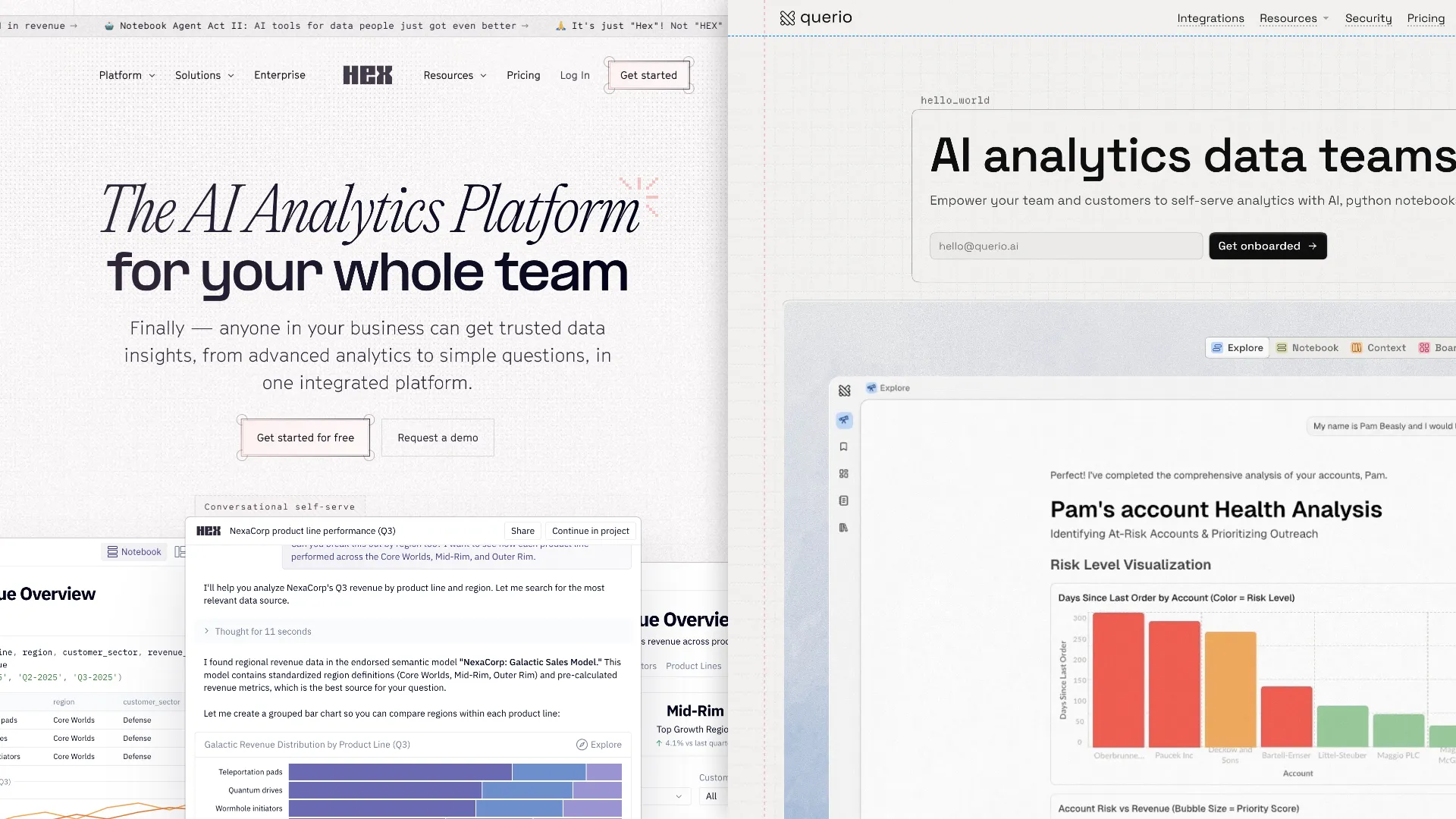
Hex is a fully integrated AI-native workspace combining notebooks, SQL, semantic models, collaborative analysis, and data app building in one environment.
Querio brings similar depth with a strong emphasis on deterministic, trustworthy results.
Both are used by serious data teams at serious companies to do complex, consequential work.
What they do well:
- Enterprise-grade depth for complex, multi-step analysis
- Semantic modeling that enforces consistent definitions at scale
- Built for data practitioners who need flexibility and power
Where they stop:
- Designed around the data team, not the whole business
- Learning curve and pricing reflect an enterprise, technical audience
- The data team benefits. The rest of the organization still waits.
What Teela Is Built to Do
Teela was built for the person who has been waiting.
Not the data scientist.
It’s the operator, the finance lead, the manager who knows exactly what question they need answered and shouldn't need to involve three other people to get there.
The foundation is how Teela handles meaning.
Before any questions get asked, Teela is trained on your actual database and your business vocabulary: the specific language your company uses, the definitions your teams have agreed on, the aliases and terms that only make sense inside your organization.
That understanding is stored in the system and enforced consistently across every question anyone asks, updated only when a human approves the change.
From there, Teela goes further than returning a result.
Ask “why February had the lowest revenue” and Teela doesn't hand back a number and stop.
It investigates: which customers pulled back, which products slowed, whether volume or pricing shifted, what operational patterns contributed.
The answer comes with context. Not just what happened, but why.
What sets it apart:
- Trained on your schema and business vocabulary before the first question is asked
- Meaning enforced system-wide, updated only with human approval
- Investigates the cause behind a result, not just the result itself
- Answers saved as DataClips: scheduled, shared, and reusable across teams
- Connects to SQL databases, spreadsheets, Excel files, and CSV uploads
- Designed so non-technical users get real answers from the first session
The knowledge your organization builds doesn't live in one person's head or one chat thread.
It lives in the system, available to the next person who needs it, and the one after that.
Ask “why February had the lowest revenue” & Teela doesn't hand back a number and stop.

What to Ask Before You Choose
The right questions cut through a lot of noise.
Do your questions stay the same week to week or do they keep evolving? Static reporting needs a dashboard. Everything else needs something that can keep up.
Who actually needs answers, and how fast? If the answer has to go through a data team first, the tool is only as useful as the queue in front of it. The best tools put answers directly in the hands of the people making decisions.
When you get a number, do you trust it? Consistency across teams and over time isn't a nice-to-have. It's the difference between data that informs decisions and data that causes arguments about which version is right.
Do you need to know what happened or why it happened? Knowing revenue dropped in February is useful. Knowing which customers pulled back, which products slowed, and what drove it is what actually lets you do something about it.
Does your whole team need access, or just your data team? The tools that serve everyone (not just practitioners) are the ones that actually change how a business operates.
Most teams already know what they need. They need answers they can trust, available to everyone who needs them, with enough context to act on.
The question is just whether the tool they're evaluating was built to deliver that.
Teela is currently in beta. Book a free demo at teela.ai and see what it finds in your data.